Economic Substance

Published: 17 Oct 2019
Type: Insight

Economic Substance:  International Tax Co-Operation (Economic Substance) Law, 2018


The Cayman Islands’ International Tax Co-operation (Economic Substance) Law, 2018 (ES Law) and The International Tax Co-Operation (Economic Substance) (Prescribed Dates) Regulations, 2018 (ES Regulations) came into force on 1 January 2019. The regime became applicable immediately to new relevant entities incorporated or registered after that date. For existing relevant entities, there was a six-month transition period which ended on 1 July 2019.

The ES Law is supplemented by the Cayman Islands guidance for economic substance for geographically mobile activities (ES Guidance Notes), version 2.0 of which was published on 30 April 2019.

A “relevant entity” is only in scope of the Cayman Islands economic substance requirements if and to the extent that it conducts any “relevant activity”. Cayman Islands exempted companies, limited liability companies (LLCs), limited liability partnerships (LLPs) and foreign companies registered in the Cayman Islands will be considered to be “relevant entities” unless they meet the definition of “investment fund” or “domestic company” under the ES Law, or are “tax resident outside of the Cayman Islands”, as contemplated under the ES Law and within ES Guidance Notes.

Relevant activities include banking business, distribution and service centre business, financing and leasing business, fund management business, headquarters business, holding company business, insurance company business, intellectual property business and shipping business.

Whilst many clients have already undertaken the exercise of classifying their Cayman Islands entities for purposes of the ES Law, we continue to get enquiries from persons with existing entities seeking guidance on the regime and its application to their circumstances. We strongly recommend that anyone who has not yet addressed the implications of the ES Law on their Cayman entities do so as a matter of urgency. Appleby would be pleased to assist in this endeavor. Please contact a member of our Regulatory Team or your usual Appleby contact.

Additionally, we encourage those who have already undertaken the classification exercise to remain mindful of certain developments that are still anticipated to occur before year end, as discussed below.

ES Regulations and Guidance Notes

In an industry update circulated on 26 July 2019, the Department of International Tax Cooperation (DITC) advised, among other things, that version 3.0 of the ES Guidance Notes was being drafted and that the next iteration of the notes would include sector-specific guidance for each relevant activity, as well as guidance for investment funds. Working groups from industry sector groups met with the DITC at the end of August 2019. The consultation period has now concluded, and version 3.0 of the ES Guidance Notes is anticipated to be released towards the end of October or at the beginning of November 2019.

On 10 September 2019, the Cayman Islands government (through Cabinet) amended the ES Regulations to include provisions relating to “MNE Groups”. “MNE Group” refers to any group that includes two or more enterprises for which the tax residence is in different jurisdictions or includes an enterprise that is resident for tax purposes in one jurisdiction and is subject to tax with respect to the business carried out through a permanent establishment in another jurisdiction”. MNE Groups are specifically excluded from the definition of “domestic company” under the ES Law in order to ensure that a company which is carrying on business both within the Cayman Islands and also business exterior to the Cayman Islands cannot avail itself of the exemption from the definition of “relevant entity” for domestic companies. Corresponding changes to the ES Guidance Notes version 2.0 were published on 17 September 2019.

ES Notification and Reporting

Exempted companies, foreign companies, LLCs and LLPs will each be required to file a notification form under the ES Law (ES Notification). The ES Notification will be filed via the General Registry system of the Registrar of Companies of the Cayman Islands. The notification form will be separate from the General Registry’s annual return for companies but, in terms of timing, the completion and filing of the ES Notification will be a prerequisite to filing the annual return. The below reference document published by the DITC shows exactly what each entity will have to disclose in the ES Notification form:
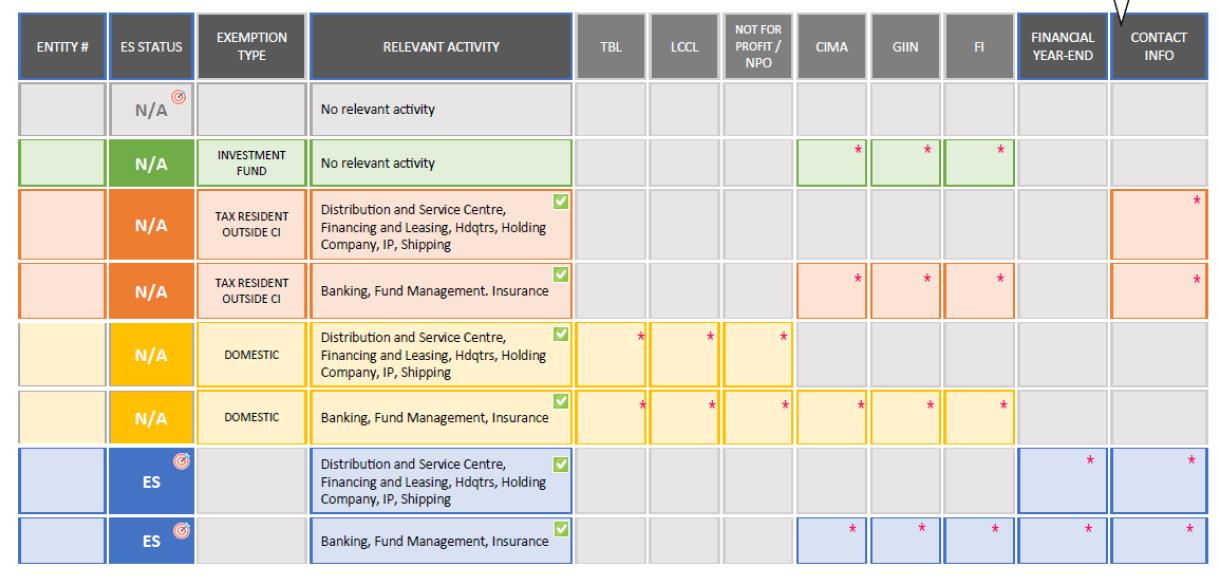
Entities claiming to be exempt by virtue of tax residence elsewhere will be required to support their claim with additional information that follows the OECD’s Nominal Tax Jurisdiction schema, which is still in development.

Timing

  • October 15 – ES Notification form released
  • Late October/early November – sector specific guidance notes
  • July 2020 – ES Portal should be live
  • December 2020 – first ES return due

Economic Substance Online Tool

Appleby has an online Economic Substance Entity Classification Questionnaire which offers guidance through the economic substance regime of the Cayman Islands (as well as the regimes of Bermuda, the BVI, Guernsey, the Isle of Man and Jersey).  It was developed by our legal and regulatory experts and is available online free of charge.  If an entity is in scope of a jurisdiction’s economic substance requirements, the Questionnaire will provide a summary of steps required to meet those requirements.


Share
More publications
IWD website preview
9 Mar 2026

International Women’s Day 2026 Roundtable: Rights. Justice. Action. For all women and girls.

As we recognise International Women’s Day 2025, we are reminded that gender equality is not just a vision – it’s a call to action.

Appleby-Website-Regulatory-Practice
3 Mar 2026

Cayman Islands Regulatory Round Up - Winter 2025/26

The round-up provides a concise yet thorough summary of regulatory developments relevant to financial service providers (FSPs) and other stakeholders in the Cayman Islands. It highlights key legislative changes, publications by the Cayman Islands Monetary Authority (CIMA), updates on financial sanctions, and anticipates upcoming changes through "horizon scanning”. Links to the underlying CIMA publications, as well as related Appleby published briefings and e-alerts are available throughout this document. The information provided is “as of” 28 May 2025.

Appleby-Website-Regulatory-Practice
16 Feb 2026

Preparing for and Managing a CIMA Onsite Inspection

The Cayman Islands Monetary Authority (CIMA) is empowered, under the Monetary Authority Act and certain other regulatory laws, to inspect regulated financial service providers (FSP) in the Cayman Islands such as banks, trust companies, administrators, investment managers and virtual asset service providers for compliance with applicable regulatory frameworks. CIMA routinely conducts onsite inspections of such regulated entities – which can be full-scope (involving a review of all areas of a regulated entity's business operations) or thematically focused on specific areas such as corporate governance and/or internal controls, policies and procedures pertaining to AML/CFT/CPF. With the breadth and number of onsite inspections carried out by CIMA having increased through 2024 and 2025 we consider, in this briefing: (i) the CIMA onsite inspection process; (ii) the latest feedback available from CIMA in respect of inspections conducted to date; and (iii) some frequently asked questions in relation to CIMA onsite inspections.

Appleby-Website-Arbitration-and-Dispute-Resolution
16 Feb 2026

Injunctive Relief in Another Form? Cayman Court's Jurisdiction to Appoint JPLs Despite Ongoing Arbitration

In Peakwave Investment Management Ltd v Energy Evolution GP Ltd [link],[1] the Grand Court confirmed that it has jurisdiction to appoint provisional liquidators notwithstanding the fact that the company’s shareholders are engaged in an arbitration over its affairs, as mandated by a binding arbitration agreement. This article considers the decision and its implications.

The Exception To The Rule: Stricter Test Applies Where Granting An Interlocutory Injunction Would Shut Out Trial
11 Feb 2026

When the Court intervenes… and when it does not: Grand Court Reaffirms Limited Curial Intervention in Support of Foreign Arbitrations

The Financial Services Division of the Grand Court’s judgment in In the matter of A v B & C (FSD 270 of 2025) provides a timely reminder of the proper boundaries between national courts and international arbitration tribunals in respect of the grant of interim relief. The decision underscores the Cayman Islands' commitment to the principle of limited curial intervention and confirms that the Court’s powers under section 54 of the Arbitration Act 2012 are ancillary to the arbitral process and are only to be exercised when the tribunal cannot provide effective relief itself. The judgment helpfully sets out clear parameters for those seeking ancillary relief and highlights that the Cayman courts will support arbitration proceedings without supplanting them.

Website-Code-Cayman-2
5 Feb 2026

Recusal For Apparent Bias Is Not A New Frontier

In Re New Frontier Health Corporation,[1] Justice Doyle decided to recuse himself, such that he would not hear the trial listed to commence weeks later, on the basis that he made findings in his recent Re 51job Inc judgment, as to the reliability and credibility of the same two experts who would give evidence at the New Frontier trial. The New Frontier judgment represents a further endorsement by the Cayman courts of the fundamental maxim that justice must not only be done, but must be seen to be done.

Appleby-Website-Corporate-Practice
4 Feb 2026

The New Crypto-Asset Reporting Framework – Relevance for Cayman Investment Funds

The Tax Information Authority (International Tax Compliance) (Crypto-Asset Reporting Framework) Regulations, 2025 (CARF Regulations) came into effect on 1 January 2026 and provide for the collection, reporting and automatic exchange of information on transactions in crypto-assets.  The CARF Regulations will operate in a similar fashion to the existing Cayman Common Reporting Standard (CRS) regime which facilitates the automatic exchange of financial account information.  For information on recent changes to the CRS, please see our December advisory here.

Appleby-Website-Regulatory-Practice
27 Jan 2026

CIMA Launches Prudential Information Survey for SIBA Registered Persons

The Cayman Islands Monetary Authority (CIMA) has published a General Industry Notice launching a new Prudential Information Survey for Registered Persons under the Securities Investment Business Act (SIBA) of the Cayman Islands.

The Exception To The Rule: Stricter Test Applies Where Granting An Interlocutory Injunction Would Shut Out Trial
15 Dec 2025

Aquapoint LP v Fan: Privy Council Confirms Equitable Constraints Can Override Strict Contractual Rights in Cayman ELP Winding Up

In its recent judgment in Aquapoint LP (in Official Liquidation) v Fan,[1] the Privy Council upheld the judgments of the Grand Court and Cayman Islands Court of Appeal (CICA). The ruling confirms that the exercise of strict legal rights under a limited partnership agreement – even one containing detailed contractual terms and “entire agreement” clauses – can nevertheless be subject to equitable considerations in certain circumstances. Where those equitable considerations arise, they may justify the winding up of an exempted limited partnership on the “just and equitable” basis. Appleby acts for the joint official liquidators of Aquapoint; for further details on the background of this case, see Appleby’s previous article here.